I love to sift through my google reader feed and my Zite content on Sunday mornings. In days gone by (oh the loss of good newspapers) I would spend the morning with the NYT sunday edition and the local Arkansas papers along with a big pot of coffee. Sprawled out across the living room rug. Never really knew what to expect. What interesting tidbit would jump out at me at this time? Is there a topic I did not even knew existed? With Zite and google reader not so much. Zite's algorithms are too small in the categories it provides. I have used this web app for about a year and now the majority of articles presented for my amusement are science (primarily biology) related. The Google reader is a little better as it doesn't predict anything, just gives me exactly what I ask for. Alas, no surprises. I still miss my Sunday morning papers (they just aren't up to par) and every once in while I will purchase said papers and settle in on a sunday morning to read. It's just not the same as the content is now 50% of what it was a decade ago. That said, today's surprises.
A website called book porn. Just pictures (think pintrest) of book shelves. Amazing pictures of book shelves. There was even a book shelf made of books strategically stacked to create the book shelf without any other structural component.
A website (i think it is a tumblr account but i don't understand tumblr) titled "Things I Learned as a Field Biologist. I read post after post and laughed. I have one professor this term who refers to students as 'Biologists' After reading this author's small stories I now realize...I am a field biologist! I am a field biologist? WOW That is so cool.
The intelligent octopus https://vimeo.com/44791802
The Washington Post has an article with the headline "In Hawaii, fisheries service relaxes bycatch limits on endangered sea turtles" stating that swordfishermen can catch 26 leatherback and 34 loggerhead turtles before suspending fishing. Appalling, right? If you read the entire article you find that, according to Michael Tosatto (regional administrator for the fisheries service) no turtles were killed this year. All were released alive. If this is true and the bycatch is not resulting in death of turtles and the fishermen are reporting truthfully, then is there a problem here? What a great research opportunity. If a scientist could partner with the swordfish fishermen and geo-tag the turtles caught on the swordfish hooks a wealth of information could be obtained without having to create and implement a large, expensive study. Maybe someone is already doing this, it just doesn't make the news.
Sunday, October 7, 2012


Wednesday, September 5, 2012
The Ozark Hellbender
Wow, two posts in one week. I can't help it. I'm really having a great time this semester. I've given my first talk (just a couple of minutes on a news item of the day), written my first lab report (plant ecophysiology), already working on my second lab report (also plant eco). That may sound a little crazy that we've done two lab reports but the first report was a short lab study of plasticity in leaf morphology and the second lab is a refresher on plant growth graphing of sigmoid curves and the math that goes with it.
Friday we'll be visiting the site of our wetland remediation (Practicum) for the first time which is awesome.
The other major project is in Anthropology of the Ozarks and I have developed the topic for my research project. The current incarnation of my project is a literature review of the research involved in the attempt to save the Ozark Hellbender (Cryptobranchus alleganiensis bishopi) which was put on the endangered species list in 2011. I say current incarnation because tomorrow in class we present the outline to small groups and get feedback, input ect. After tomorrow's class the outline may change.
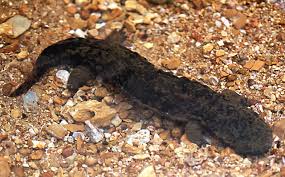
Photo courtesy of the Sierra Club copied from Google Images
As always,
thanks for reading
Friday we'll be visiting the site of our wetland remediation (Practicum) for the first time which is awesome.
The other major project is in Anthropology of the Ozarks and I have developed the topic for my research project. The current incarnation of my project is a literature review of the research involved in the attempt to save the Ozark Hellbender (Cryptobranchus alleganiensis bishopi) which was put on the endangered species list in 2011. I say current incarnation because tomorrow in class we present the outline to small groups and get feedback, input ect. After tomorrow's class the outline may change.
Photo courtesy of the Sierra Club copied from Google Images
As always,
thanks for reading
Monday, September 3, 2012
A new semester has started
It is the second week in the new semester and I am excited about the work I will be doing this semester. I am part of a team conducting the initial assessment of a piece of property that a local family is putting into a wetlands mitigation bank. I'll be working primarily in the plant population assessment and will also assist the other students working on vertebrate assessment. The first look at the property will take place on Friday and I'll have an update then.
I have an independent research project my Plant Ecophysiology class that is yet to be determined. Papers to write in Religion and Pop Culture, Cultural Anthropolgy, and Water Resources. I also will be conducting an independent research project in Cultural Anthropology--the Ozarks.
I have an independent research project my Plant Ecophysiology class that is yet to be determined. Papers to write in Religion and Pop Culture, Cultural Anthropolgy, and Water Resources. I also will be conducting an independent research project in Cultural Anthropology--the Ozarks.
Thursday, May 10, 2012
Nature Retaliates
I was reading a blog post http://scienceline.org/2012/04/manhattan-the-next-atlantis/ (in case you want to check it out) and the statement was made; "we are not safe from the retaliation of which nature has already demonstrated itself capable." and I got to thinking. Retaliation? Retaliation! Hmmmm. I really don't think that Nature is going to retaliate against anything or anybody. I don't think Nature notices us. That isn't to say that humans have no effect on nature but this entity that is referred to as Nature is an abstract concept we use to make sense of the world. Using a word like 'retaliate' causes negative emotional responses from readers serving only in creating a frenzy in which people want to fight, against something, anything, each other. We can focus on an issue and discuss solutions without fear mongering. The truth is emotional enough.
Wednesday, April 25, 2012
The Gulf Oil Spill 2 Years later
My ichthyology professor, last week, asked us to read articles concerning the newly discovered effects of the BP Oil Spill over the weekend. Being the over eager student that I am I dove into the subject matter. However I was quickly sidetracked by other articles, studying for finals and cooking for the week ahead. So today I open up my google reader and return to the subject. I happened upon an article discussing the differing approaches taken by McNutt (USGS) and Lubchenco (NOAA) in the weeks and months during attempts at mitigation.http://www.eenews.net/public/Greenwire/2012/04/20/1
The issue that struck me, and I have read this in other places, was the idea that it is a necessity for peer review of the research before findings could be provided to the government or to the public. The article provides the following quote: "We rightfully got a lot of grief from the academic community," McNutt said during a recent interview. "But we had no option to get it peer-reviewed! If there was an action to get it quickly turned around and reviewed, we would've loved to have taken it."
I stopped reading at this point and realized that 23 years as a police officer made me rebel from this attitude. Just make a decision, take action! A visceral reaction on my part but still, I can't help it. I've been a student now for a couple of years and understand the importance of peer review but not for something this drastic. The BP oil spill required action not peer review. I'm not going to monday-morning-quarterback any of the actions taken by specific people but we as a scientific community should assess honestly what was done, what wasn't done that should have been, and what to do next time. This is something that we do in police work after every crisis situation. There will be a next time. Drilling continues. The scientific community should be working on a game plan for what to do, how to jump over peer review in situations such as a massive oil spill, and allow the experts to make decisions on the fly.
The issue that struck me, and I have read this in other places, was the idea that it is a necessity for peer review of the research before findings could be provided to the government or to the public. The article provides the following quote: "We rightfully got a lot of grief from the academic community," McNutt said during a recent interview. "But we had no option to get it peer-reviewed! If there was an action to get it quickly turned around and reviewed, we would've loved to have taken it."
I stopped reading at this point and realized that 23 years as a police officer made me rebel from this attitude. Just make a decision, take action! A visceral reaction on my part but still, I can't help it. I've been a student now for a couple of years and understand the importance of peer review but not for something this drastic. The BP oil spill required action not peer review. I'm not going to monday-morning-quarterback any of the actions taken by specific people but we as a scientific community should assess honestly what was done, what wasn't done that should have been, and what to do next time. This is something that we do in police work after every crisis situation. There will be a next time. Drilling continues. The scientific community should be working on a game plan for what to do, how to jump over peer review in situations such as a massive oil spill, and allow the experts to make decisions on the fly.
Saturday, February 4, 2012
Master's degree
Update to finding a research adviser.
So last week my Ichthyology professor gave me some advice. Don't choose the grad school, choose the graduate adviser. Wow. And this professor already has someone in mind that would fit my personality and career goals. So my next step is to stay close to this professor.
New info.
I found a great app for flash cards. I'm using it for Ichthyology and am finding it to be intuitive and easy to navigate. It's called "flashcards" and its designed for the ipad. The price is $2.99 which is not bad since a stack of 3 X 5 cards will cost about that. This app allows typed or hand written and has a print option.
Biology club committee for organizing fund raisers. Am I taking on too much? Naw.
So last week my Ichthyology professor gave me some advice. Don't choose the grad school, choose the graduate adviser. Wow. And this professor already has someone in mind that would fit my personality and career goals. So my next step is to stay close to this professor.
New info.
I found a great app for flash cards. I'm using it for Ichthyology and am finding it to be intuitive and easy to navigate. It's called "flashcards" and its designed for the ipad. The price is $2.99 which is not bad since a stack of 3 X 5 cards will cost about that. This app allows typed or hand written and has a print option.
Biology club committee for organizing fund raisers. Am I taking on too much? Naw.
Saturday, November 12, 2011
Faculty advisor, Research project and a Design study
I have begun the process of trying to connect with a member of the faculty who will be the best fit as an advisor. I have an appointment next week to discuss this with a faculty member who does turtle research. Before I chose him, I checked the university website and carefully read his page. I then did a little bit of Googling and found that he had co-authored a book on the biology of snapping turtles and was also able to get copies of a few of his research papers to read over. Am I over-doing it? I don't think so but then I am flying by the seat of my pants on this one. I also sought out students who have worked with this professor and/or had him as an instructor. All this preliminary work took up probably two hours of my time. I meet with him next Wednesday and the emails that we have exchanged sound promising.
I'm working out the things that will be needed to conduct an observational study on turtle basking near the river trail in North Little Rock. The idea came from reading the paper "Basking Behavior of Emydid Turtles (Chysemys picta, Graptemys geographica, and Trachemys scripta) in an Urban Landscape"
William E. Peterman1 and Travis J. Ryan2
The scientist's goal as explained in the above paper was to determine, among other things, the affect of highly managed habitat on turtle basking along canals in central Indianapolis. I intend to study how turtle basking is affected by the specific distance of a basking location is from this multi-use river trail that runs along side the Arkansas River. As I have been jotting down notes on possible research questions, how to obtain specific data, what kind of data I should collect, what tools I need and attempting to formulate a hypothesis; I am both excited and overwhelmed. The only thing I can do is jump right in. Hopefully I'm still in the shallow end of the pool.
I'm working out the things that will be needed to conduct an observational study on turtle basking near the river trail in North Little Rock. The idea came from reading the paper "Basking Behavior of Emydid Turtles (Chysemys picta, Graptemys geographica, and Trachemys scripta) in an Urban Landscape"
William E. Peterman1 and Travis J. Ryan2
The scientist's goal as explained in the above paper was to determine, among other things, the affect of highly managed habitat on turtle basking along canals in central Indianapolis. I intend to study how turtle basking is affected by the specific distance of a basking location is from this multi-use river trail that runs along side the Arkansas River. As I have been jotting down notes on possible research questions, how to obtain specific data, what kind of data I should collect, what tools I need and attempting to formulate a hypothesis; I am both excited and overwhelmed. The only thing I can do is jump right in. Hopefully I'm still in the shallow end of the pool.
Subscribe to:
Posts (Atom)